Saturday, March 30, 2013

URGENT: Liberal Columnist Calls For Ending Military Funeral Honors For Vets, “Most Veterans Did Nothing Heroic”

h/t MK


http://redflagnews.com/headlines/liberal-columnist-calls-for-ending-military-funeral-honors-for-vets-most-veterans-did-nothing-heroic


URGENT: Liberal Columnist Calls For Ending Military Funeral Honors For Vets, “Most Veterans Did Nothing Heroic”…

We encourage that you share your thoughts with this columnist, Bill McClellan, here: bmcclellan@post-dispatch.com

. . . According to the program’s website, it is funded by the federal government and the Missouri National Guard Trust Fund.
Both the federal government and the state government are broke. So why are we providing military funeral honors for all veterans? It is a nice gesture we can’t afford.
Certainly, men and women killed in combat deserve full military honors. It’s a way for the country to say, “We honor the memory of those who died in our service.” These military honors — and the thought behind them — are intended to provide some solace for the families of the fallen.
But what about the guy who spends a couple of years in the military and then gets on with his life? Bear in mind that most veterans did nothing heroic. They served, and that’s laudable, but it hardly seems necessary to provide them all with military honors after they have died. In fact, it seems generous enough to provide veterans and their spouses with free space and headstones at a national cemetery.
Why not let the veterans organizations provide military honors at the funerals of their members? If a person gets out of the Marine Corps and wants to stay connected, he can join the Marine Corps League. I’m sure the 101st Airborne has an association. In a more general vein, we have the American Legion and the VFW.
Providing military honor funerals for their members would be a boon to these organizations. Membership would presumably climb, and veterans who want the military funerals could still get them.
Everybody knows government needs to cut costs.
This is exactly how you do it.

Thursday, March 28, 2013

Please have a look and consideration of TroopsDirect.org

PLEASE think about even a small contribution.

These are not for goodies, but necessities that our troops cannot get through normal supply channels.

Thank you.

http://troopsdirect.org/


If there is a black below, hold your left clicker wonder the cursor and see what's there.


TroopsDirect is different and we take our mission very seriously.

It started with a simple care package to a long time friend, fellow USC Trojan and Marine Corps Captain deployed to one of the bloodiest regions of Afghanistan. His email of thanks not only expressed his gratitude but also the need for him to share the contents of my package with the 150 Marines under his command. It was then that I realized that there were thousands of servicemembers on the front lines who were in desperate need of an ongoing supply of the essential staples that would keep them healthy, sharp, motivated…and alive.
So my quest began with the goal of giving our frontline servicemembers anything and everything I could possibly muster. The difference however was that I wasn’t going to do it one soldier or Marine at a time in shoe box sized packages but rather at unprecedented levels. I would ship to entire units in bulk. For the uninitiated, that is upwards of 1000 servicemembers that would be supported in a single shipment. Furthermore, I was going to take the guesswork out of the process and communicate directly with the front lines in order to ship items that they specifically needed and requested. With that, I reached out to my friends and to the corporate contacts that I've made through my near 20 years as a business executive. In a matter of days, support for this mission was received with the energy of a tsunami and TroopsDirect was born.
Soon after, the gauge for measuring TroopsDirect’s support went from ‘boxes and pounds’ to ‘pallets and tons’. In the following months, a (very) high ranking military official stated that TroopsDirect was a game changer for his units and that an organization such as TroopsDirect comes around once in a generation of our military. Another military leader stated that we were saving lives on a daily basis. Hearing those words, we knew we were doing something right.

I encourage you to visit our 'Life Outside the Wire' page for a clearer understanding of what our troops experience on a daily basis. They were once those that grew up on your block, your former schoolmates and work colleagues. They voluntarily put themselves in harms way for you, our friends and neighbors, our sons and daughters and our nation every single day. Note that every photo you see and story that you read on TroopsDirect.org was sent to us by the servicemembers we are committed to support.
TroopsDirect is not about endorsing war or the politics that may surround it. We are simply about providing for our servicemembers in an unprecedented manner. And until there is no more war, TroopsDirect will be there for our country and her servicemembers.
Thank you in advance for your support and contributions.


Aaron Negherbon
President & Founder
TroopsDirect.org


profile

TroopsDirect.org

TroopsDirect

TroopsDirect profile
TroopsDirect TroopsDirect's own Aaron Negherbon on Sean Hannity Radio in 7 minutes (1:30 pst). He'll be telling it like it...fb.me/2xLhthim821 minutes ago · reply · retweet · favorite
TroopsDirect profile
TroopsDirect A little Wednesday humor... fb.me/LocxsqGg22 hours ago · reply · retweet · favorite
TroopsDirect profile
TroopsDirect Partial pic of items going to a K9 handler in Afghanistan. He lost his gear when an IED blew up his supply truck...fb.me/2g6UXCzGY2 days ago · reply · retweet · favorite
TroopsDirect profile
TroopsDirect I posted a new photo to Facebookfb.me/2iPvHyfva3 days ago · reply · retweet · favorite

TROOPSDIRECT.ORG | 2400 CAMINO RAMON, SUITE 105 | SAN RAMON, CA 94583 | 877.97.TROOPS
501c3 #27-3046842 | PRIVACY POLICY | SITE BY RISING SUN MEDIA


Peyton Manning USO Trip Report

h/t RC

Ed Note:  If there is no text, hold down your left clicker and run your cursor over all the white space and the text will magically appear.


 Peyton Manning USO Trip Report

Glad he’s our QB..
One year ago, Peyton Manning ended one leg of his professional football journey, a 13-season run with the Indianapolis Colts, and began another that landed him with the Denver Broncos.

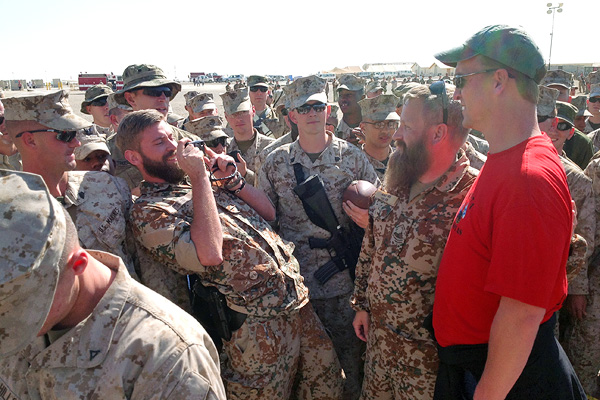
Fast-forward to the present. Manning just completed a new personal journey with the USO, visiting the men and women of the U.S. military in what he describes as a life-changing event.

On a tour that ran from Feb. 25 to March 2, Manning was accompanied by Adm. James Winnefeld, the ninth vice chairman of the Joint Chiefs of Staff and the second highest-ranking officer in the U.S. military. Manning was introduced to Winnefeld by Colts quarterback coach Clyde Christensen, who also made the trip along with free-agent wide receiver Austin CollieTampa Bay Buccaneers wide receiver Vincent Jackson, who was raised in a military family; and former major league pitcher Curt Schilling, a regular on the USO tour circuit.

Manning kept a detailed journal of his travels. When members of the military staff read some of his entries as the trip was nearing its conclusion, they encouraged Manning to share them publicly because they felt it would be good for troop morale.
Here is an edited version of Manning's visit with the troops:

Monday, Feb. 25

[+] Enlarge http://a.espncdn.com/photo/2013/0304/nfl_peyton_uso9_400.jpg

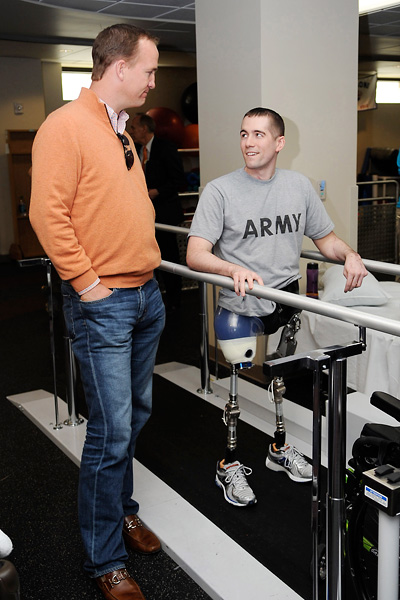
Photo by Air Force Master Sgt. Chuck Marsh.  Manning visits with Army 1st Lt. Nicolas Vogt at Walter Reed National Military Medical Center before heading overseas on the USO tour.

On plane right now, we are flying to Rota, Spain. We will visit troops there all day, then fly to Naples, Italy, Tuesday night to visit some more troops. Today we took a tour of the Pentagon and went to Walter Reed Hospital to visit the wounded warriors. I visited with many amputees while they were rehabbing and learning to walk with their prosthetic legs. Their attitudes on life, determination to get better and desire to remain in the military were very inspiring. Signed a lot of footballs and took lots of pictures. If I ever whine or complain about anything ever again, then shame on me after what I witnessed today.

Our leader on this USO tour is Adm. James Winnefeld. I have been talking to him on the plane for the past two hours, and he is as impressive a leader as I have ever been around. I asked him many questions about his thoughts on leadership as it may relate to playing quarterback, and he had some great insight. Our country is lucky to have him.

The rehab staff here is outstanding. After our visit to Walter Reed, the admiral took Curt Schilling, Clyde Christensen and me to his 14-year-old son John's baseball practice. Afterward, this same group went to Arlington National Cemetery to see the Tomb of the Unknown Soldier and JFK's tomb. It was my first time to either site and it was pretty moving. We had dinner at the admiral's house in a military neighborhood. He told me that Gen. Patton once resided in the home. Threw some passes with the admiral's son, L.J. We then boarded a plane that looks like Air Force One on the outside and off we went.

Tuesday, Feb. 26

Peyton Manning
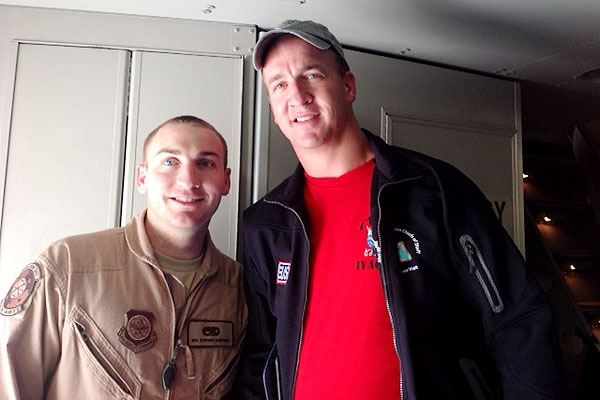
USO Photo by Dave Gatley. Manning poses with troops and their families at Naval Air Station Sigonella in Italy.

We just took off from Spain and are flying now to Naval Air Station Sigonella in Italy. We will see troops there and then fly on to Naples. In Rota, the first stop we made was a plane hangar where about 40 or so troops were gathered. The admiral presented the Bronze Star to three troops who had performed outstanding duties in action in Afghanistan. It was a short ceremony but a huge honor for these three soldiers.

[+] Enlarge http://a.espncdn.com/photo/2013/0301/nfl_peyton_schilling_600.jpg

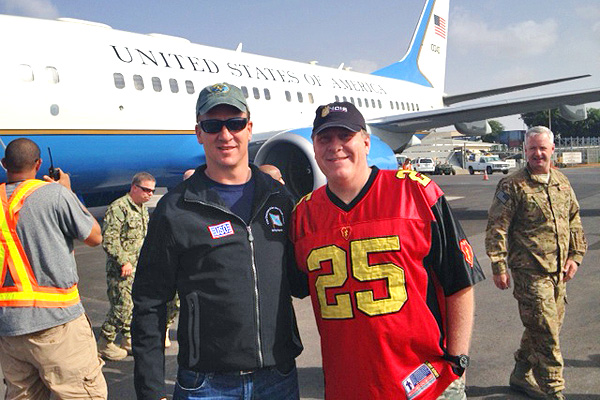
Clyde Christensen for ESPN. Manning and Curt Schilling wait to board the C-40 plane that carried them on much of the tour.

We got to visit with the troops there. We then went over to the main base and visited with more troops and many family members. Lots of family members live over here with these troops on the base or were visiting. That is not the case in Afghanistan, where no family members will be there. Lots of football fans. I spoke briefly onstage and thanked all the troops for their service. I told them that one of my driving forces in my football career has always been to be accountable to my team, and to do my job to help the team. Nowhere is that philosophy more defined and displayed than in our armed forces.

The base commander gave me three names to call out and I threw a pass to each one of them -- a football signed by me, Austin Collie and Vincent Jackson. Two women and one male. The man, Eric Wagner, and first woman, Linda Pena, each dropped the pass twice until they finally caught it. The second female, Mara Giardini, caught it the first time. They all got big applause when they caught the pass. We then took group pictures with the people present, probably 200 people or so. The other visits will be much larger, I am told. I stood next to Schilling in the photo line. His dad was in the military, and he is really good with the troops. He told them that he hates all Yankees fans except the ones in the military.

One comment that stuck out was when a soldier thanked me for coming over and "bringing some of home" to him and his fellow soldiers. That told me we were doing a good deed for these special men and women. Let me tell you, whatever store over here in Spain sells footballs has to be sold out. Wish I had some stock in it.

Wednesday, Feb. 27

Peyton Manning
USO Photo by Dave Gatley. Soldiers were selected to catch passes from Manning at every stop of the tour.

On plane right now flying from Camp Lemonnier, Djibouti, to the 380th Air Expeditionary Wing, Southwest Asia. We will spend the night in a hotel there tonight and then fly to our next stop in the morning. Djibouti is home for about 2,000 troops. No families over here, military personnel only. Did the show throwing footballs again. Took pics and shook hands with a lot of troops. They don't sell footballs in Djibouti. Any football that I signed was worn down because the troops throw it around over on the base.

Afterward, we went to the cafeteria and had dinner with the folks. I sat with about four guys who are what they call Seabees, part of the Navy. It really is CB, which stands for Construction Battalion. They have been around since WWII. They are building anything that our forces need -- runways, hangars, smaller command bases. Took some more pics and signed some stuff in the cafeteria and then we were sent to the aircraft base to fly back out. Before that, a guy grabbed me by the arm and told me he was a special op from Colorado and could I come meet the rest of his team, all of whom were from Colorado and all big Broncos fans. He said that I had to go with him and to his team's office and that he should not take me in there because of the highly classified intelligence in there but that he would ask for forgiveness later.

As I was walking over there I asked a member of the admiral's staff, Capt. Ross Meyers, "What does special ops mean, exactly?" and he said that I was about to go meet Navy SEALs, all from Colorado. We took a group picture, I thanked them for their service, and they thanked me for coming. Then I headed back to the bus to head to our plane. Before we boarded, we got to watch three F-16s take off back-to-back-to-back. Serious, serious speed. Have seen these flying over me before kickoff a bunch, but never on a takeoff. It was quite a spectacle. They told us we were not allowed to video the takeoffs for security reasons. (Naturally, Schilling filmed the whole thing with his camera phone.)

I learned all Navy SEALs are studs but then there are special SEALs. They are known as the Elite Elite. They will shoot up to 100,000 rounds of ammo a year in practice shooting. They are doing the major specialized jobs (i.e. killing bin Laden, those pirates who kidnapped that boat captain for ransom a few years ago). Pretty amazing stuff.

Peyton Manning
USO Photos by Dave Gatley. There was plenty of Broncos gear for Manning to sign for troops throughout the tour.

Thursday, Feb. 28

Thursday was truly an awesome day. Flew out on a C-2 from the UAE to an aircraft carrier, the USS Stennis. I'm not allowed to say where the ship was located exactly, but I can say it was outside the Arabian Gulf. We did the landing on the ship like you see in the movies with the cable wire. About 12 of us, helmets and goggles on for takeoff and landing. I got to sit up in the cockpit for half the flight. They let me make a few announcements on the PA system. I announced that in order for us to land we needed Curt Schilling and coach Clyde Christensen to please sit on opposite sides of the plane for weight-balance issues. Pilots got a good laugh out of that one.

The teamwork displayed between these pilots and the crew on the ship was absolutely incredible. Once we were on the ship, we got to watch other planes land. Everybody has a role. The purple shirts -- grapes, as they call them -- are in charge of fuel. Yellow shirts are flight-deck directors; white shirts are safety; red shirts are ordnance, salvage, crash situations. It was awesome to see and understand just how skilled our military personnel are in this country and how much pride they take in their profession.

We were greeted off the plane by Capt. Ron Reis, Rear Adm. Troy M. "Mike" Shoemaker and Capt. John Beaver. Three studs. Reis and Shoemaker are great leaders. Five thousand sailors on board, lot of people to lead. We did the USO show for a big crowd. The crowd was awesome for the show. Many people told me how big of a morale booster it is for us to be there. We took group pictures again with all the sailors. Great people. My body's way off with jet lag for sure but I don't get tired because these people fire me up and inspire me. I autographed a mortar for one sailor. My first mortar. He told me it was used in Desert Storm. Pretty cool.

We flew back out a la "Top Gun," zero to 150 mph in about 2 to 3 seconds. Serious jolt and rush, similar to a solid blindside hit by Bruce Smith. Went and did another show for 380th Air Expeditionary Wing. One guy dropped throws three times, poor guy. We had to bring him up real close where I had to underhand it to him to get the completion. Crowd loved it. Female officer came right after him and snagged the catch from same distance. Crowd went crazy. Bunch of people again said thanks for bringing some of America to them. That's what it's all about.

Friday, March 1

Peyton Manning
Photo by Air Force Master Sgt. Chuck Marsh.  Adm. James Winnefeld snags a pass from Manning aboard a C-17 en route to Afghanistan.

We started early today with a 6 a.m. departure from hotel. Boarded a C-17 plane at the 380th Air Expeditionary Wing, bound for Bagram Airfield, Afghanistan. Previously, aside from the plane to the USS Stennis, we had been flying a C-40, which is a blue-and-white 737. The C-17 is a hoss of a plane. It's a gray military-looking aircraft. It's used for transporting tanks, cars, Hummers, etc. I sat in the cockpit for takeoff with three other pilots, which was sweet. They let me have the PA system again once we were at cruising altitude. The pilots gave me some good aircraft lingo before I hit the button, and I hit 'em with, "This is your captain, Captain Manning speaking, welcome aboard. We are currently cruising at altitude 40,000 feet, currently looking at 35 degrees in our destination, Afghanistan. If you look out your windows, you will see quite a lot of sand. There will be breakfast served in our first-class cabin [which of course there was no such thing on this plane], but unfortunately for those of you sitting in the back in steerage, you are out of luck. [Collie and Clyde were busy taking pics outside before we boarded and got on the plane late, so they had to sit in the back of the plane.] I am currently flying the plane, and I want you to sit back, relax, and enjoy the flight. Crosscheck." Got a good ovation from the rest of the flight crew but one of the crew told me that crosscheck was not a term the pilots used, it was a flight-crew term, one that flight attendants use. I apologized and reminded her that was why I am just a dumb jock and not an Air Force pilot.

[+] Enlarge http://a.espncdn.com/photo/2013/0301/nfl_e_manning11_600.jpg

Clyde Christensen for ESPN. The best hands on the USO tour, according to Manning, belonged to Senior Airman Stephen Gasperic.

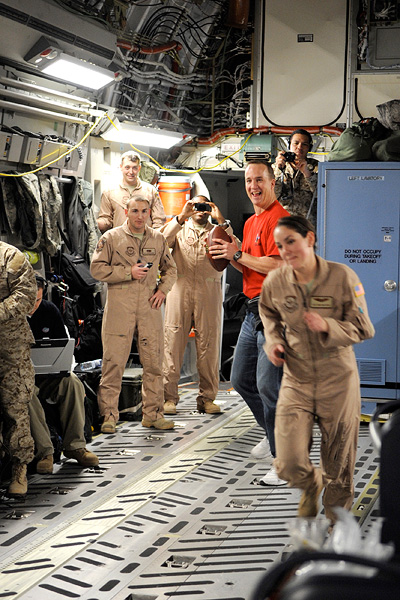
Then, I experienced a true first in my life. I have thrown footballs in lots and lots of places. Boats, prisons, schools, military bases, hospitals, golf course fairways, malls, birthday parties, bar mitzvahs, Mardi Gras floats, French Quarter, etc., but I ain't never thrown a football in an airplane. And I am not talking about little 3-yard lob passes. I was throwing 35-yard bullets to a guy who had the best hands on the entire USO tour, Senior Airman Stephen Gasperic. He was catching passes while trying to avoid falling over luggage, probably a couple of missiles back there as well for all I knew. He fell over a couple of times on some high throws, but he never dropped one. I told him Coach Fox may want to use him on third down next year in the slot opposite Brandon Stokley. Winnefeld was also throwing with me. He has a solid arm. I asked him if this throwing was OK, hoping it wasn't disrupting the crew, etc. He assured me that this is why we were there. To boost morale, to lift their spirits, to anyone in the military. Forces, pilots, engineers, you name it. That's what Bob Hope did years ago and that's what we were doing. Made me feel good.

[+] Enlarge http://a.espncdn.com/photo/2013/0305/nfl_peyton_d1_400.jpg

Photo by Air Force Master Sgt. Chuck Marsh. Staff Sgt. Christine Myers runs a pattern for Manning aboard a C-17 Globemaster flying to Afghanistan.

Finished my throwing for the day with some pass patterns to Staff Sgt. Christine Myers. Everything was solid on her part except she dropped the first two passes. On the third one, I put her on a 12-yard hook route, she snagged it effortlessly, great catch for a touchdown. I asked her if she wanted to spike it. She said yes but she wouldn't because she did not want to break any of the surveillance equipment on board. (Never heard that one after a touchdown.) The whole thing was really a special moment. One of the real highlights of the trip was seeing the smiles on their faces. All the flight crew members were filming and taking pictures of the throwing. Most of them got to catch a pass.

After 2 hours, 40 minutes of throwing while flying, we landed at Camp Bagram in Afghanistan. Home to roughly 13,000 military personnel. Snow covered the mountains over here. Walking off the plane, my mood changed. Similar to running out onto the field before a game. Just knowing that I was walking into a place where our troops are facing dangers every day. It's hard to describe in words, but it was just a different feeling. We were greeted by Air Force Brig. Gen. Joseph T. Guastella. A man's man this guy. He told us how excited his men and women were to see us. Another officer told me that our casualties are way down compared to before, which is a sign that the Afghan military is taking over more. That's certainly good to hear, but he would rather be saying zero casualties. Just another reminder of the sacrifices these men and women make. I shook hands with lots of troops right off the plane. I could tell they were pumped.

We bused over to an indoor facility and did the show. Obviously, not everyone on base could be there but a big, excited crowd was present. I immediately started taking pics and signing autographs. Thanked them for what they do and told them I pray for them and their families every night in my talk on stage and we threw the eight passes into the crowd or on stage. Best catch of the tour took place at this show by Sgt. John Albighetti. Guessing around upper 40 or 50 years old. We called his name out and the deal was you had to catch the pass right where you were standing. He was standing on a table about 40 yards back with people all around him. I took a little five-step drop, pumped left and fired what I call a hump throw into the sergeant's chest. He snatches it out of the air, falls backward into the crowd, disappears for about two seconds, then pops back up, ball raised in the air like receivers do when they want to prove to the ref they caught it. May not be in same class as Lynn Swann, David Tyree or Dwight Clark, but it has to go into a top 10 somewhere considering the moment and situation. All the troops in the crowd went nuts, huge applause. Signed a bunch more after that and took a ton more pics with the men and women. We then headed out on a flight for our next stop, Camp Bastion, Afghanistan, which the troops call Camp Leatherneck.

Camp Leatherneck is home base to roughly 3,000 troops. We were met again by the base commander, Marine Corps Maj. Gen. Mark Gurganus. Warmer here. No snow. No mountains. We headed to an outdoor staging area. The general said that the base had been rocketed the day before 12 times, and six did some damage to our airstrips. They had also lost a man and had two others wounded in a bomb explosion. This certainly made the whole thing very real to me. He said that it was good that we were here, that the troops needed a boost. As before, signed lots of autographs, took lots of pics, before and after the show. Did the same throwing routine. Lance Cpl. Rowback, a female officer, made a nice catch on about a 35-yard post pattern. You might say what's the big deal on that? Well, the big deal is she caught it while carrying an M-16 rifle on her back. I am not sure even Marvin Harrison or Reggie Wayne could have done that. Certainly another first for me on my list of completed passes.

Peyton Manning
Clyde Christensen for ESPN. Manning is reunited with kindergarten classmate Edmund Barnes, a Marine captain, in Afghanistan.

In the mass of troops, I was meeting and shaking hands and had one soldier say to me, "Good seeing you again, Peyton." I looked at him for a second, and said, "Edmund Barnes? From Mrs. Silverstein's kindergarten class at Newman?" He nodded and we had a good reunion. I recognized him because I do have a good memory on things like that, but I actually have a picture of this class in my closet in Denver. I see it often, and Edmund looks the exact same. He is a captain in the Marines, and it was awesome and a proud feeling to see him. I signed as many things and took as many pics as I could. I wished I had more time to talk to them, but they had to go back to their duties and we were heading on a seven-hour flight to Ramstein, Germany. One of the most unique moments in my life and one I will never forget. Standing in the middle of a base in Afghanistan, where a war is still going on, signing footballs, taking pictures on every soldier's iPhone, talking football, talking life, hopefully inspiring these soldiers a little bit. I know for damn sure they have inspired me.

Landed in Germany. Ramstein Air Force Base. Largest Air Force base in Europe. Fifty-thousand service men and women on base. We did the show in a mall on the base. About 2,000 people. Many of the folks there were family members of troops either working on base, deployed in Africa or Afghanistan or somewhere else, or wounded. Obviously, all of the military families have a special bond. Eight-for-8 throwing at the mall. Best catch was made by a 1-year-old baby boy wearing an 18 Broncos jersey being held by his mom wearing an 18 Colts jersey. (I took a little off this throw, by the way.) I did meet a military couple with identical twins named Peyton and Eli. Honest. I did think Peyton was a little better-looking. We took group pictures after that with many of the folks there and headed to hotel.

Saturday, March 2

[+] Enlarge http://a.espncdn.com/photo/2013/0301/nfl_peyton_d2_600.jpg

Clyde Christensen for ESPN. Manning was thanked on more than one occasion for bringing some of America to the troops overseas.

Before we took off for Andrews in D.C., we stopped at the hospital at the Ramstein Base, called Landstuhl. We met some of the doctors and nurses who talked to us about the work the hospital does. They said fewer wounded warriors are coming from down range, which I learned means Afghanistan, where the action is, which is a good sign. The goal is to treat them at the hospital in order to get them back home or to Walter Reed Hospital. The admiral thanked the staff for all of their incredible work they have been doing during this war. They are heroes as well for sure.

Boarded the C-40 plane for the nine-hour flight to D.C. About to land as I type, and it truly has been a life-changing trip for me. I have such great respect and admiration for our men and women in our armed forces. I am going to tell any athlete I know to go on a USO tour. I will do another one. I hope that I can't go to Afghanistan because that will mean our troops are out of there. I will tell athletes to go visit our wounded warriors at Walter Reed. I was lucky to receive a number of military coins from a number of soldiers. These coins represent a soldier's unit. It is a pride thing, the admiral explained to me. They will be a great tangible keepsake for me. I got a couple of hats and T-shirts as well. But my main takeaways will be intangible memories that will stay with me forever. About to land. The admiral just thanked us for participating in the tour. Schilling and I stood up and thanked him and his wife for leading the tour. And we thanked his staff. Wow, are these impressive people. We thanked the USO staff. This was the DCC's 76th USO tour. Proud to have been a part of it. Think ol' Bob Hope would have been proud as well. God bless our troops.

EU Ground the classic Gooney Bird

h/t BR

Ed Note: If you cannot read what's below, Hold the left button on your mouse down and run your cursor over it and the text will magically appear.

While working at Santa Rosa, CA., airport for Stanlake Flight Service, Walt Blakely, a former Alaskan bush pilot with C-46 and DC-3 experience we flown to Oakland, CA., airport  (OAK) to repossess a DC-3 for an aircraft holding company...We found the aircraft, had to buy two batteries and install them, buy fuel, and crank it up to fly back to Santa Rosa...We were in the run up area, when the tower controller called and told us to hold short of the active, that a sheriff deputy wanted to talk with us.  Walt shoved the throttles foreword, we rolled onto the active and took of and flew to Santa Rosa...We didn't know that someone had removed the hydraulic fluid and the landing gear wouldn't lower.  So, while Walt flew around, I hand cranked the gear down, and it locked into position.  Walt then landed........Oh well, what the heck, all in a days work.....


EU Ground the classic Gooney Bird
  Now the DC3 has been grounded by EU health and safety rules

  
'It groaned, it protested, it rattled, it ran hot, it ran cold, it ran rough, it staggered along on hot days and scared you half to death.

  
'Its wings flexed and twisted in a horrifying manner, it sank back to earth with a great sigh of relief. But it flew and it flew and it flew.'

  
This is the memorable description by Captain Len Morgan, a former pilot with Braniff Airways, of the unique challenge of flying a Douglas DC-3.


It's carried more passengers than any plane in history, but -
  
Now the DC-3 has been grounded by EU health and safety rules.


&nbs p;
  
The DC-3 served in World War II , Korea and Vietnam, and was a favourite among pilots!


For more than 70 years, the aircraft known through a variety of nicknames --- the Doug, the Dizzy, Old Methuselah, the Gooney Bird, the Grand Old Lady --- but which to most of us is simply the Dakota --- has been the workhorse of the skies.
  
With its distinctive nose-up profile when on the ground and extraordinary capabilities in the air, it transformed passenger travel, and served in just about every military conflict from World War II onwards.
  
Now the Douglas DC-3 --- the most successful plane ever made, which first took to the skies just over 30 years after the Wright Brothers' historic first flight --- is to carry passengers in Britain for the last time.
  
Romeo Alpha and Papa Yankee, the last two passenger-carrying Dakotas in the UK , are being forced into retirement because of --- yes, you've guessed it --- health&safety rules.
  
Their owner, Coventry-based Air Atlantique, has reluctantly decided it would be too expensive to fit the required emergency- escape slides and weather-radar systems required by new European rules for their 65-year-old planes, which served with the RAF during the war.
  
Mike Collett, the company's chairman, says: "We're very saddened."
  
The end of the passenger-carrying British Dakotas is a sad chapter in the story of the most remarkable aircraft ever built, surpassing all others in length of service, dependability and achievement.
  
It has been a luxury airliner, transport plane, bomber, fighter and flying hospital, and introduced millions of people to the concept of air travel.
  
It has flown more miles, broken more records, carried more passengers and cargo, accumulated more flying time and performed more 'impossible' feats than any other plane in history, even in these days of super-jumbos that can circle the world non-stop.
  
Indeed, at one point, 90 percent of the world's air traffic was operated by DC-3s.
  
More than 10,500 DC-3s have been built since the prototype was rolled out to astonished onlookers at Douglas's Santa Monica factory in 1935.
  
With its eagle beak, large square windows and sleek metal fuselage, it was luxurious beyond belief, in contrast to the wood-and-canvas bone shakers of the day, where passengers had to huddle under blankets against the cold.
  
Even in the 1930s, the early Dakotas had many of the comforts we take for granted today, like on-board loos and a galley that could prepare hot food.
  
Early menus included wild-rice pancakes with blueberry syrup, served on bone china with silver service. 


For the first time, passengers were able to stand- up and walk- around while the plane was airborne.
  
But the design had one vital feature, ordered by pioneering aviator Charles Lindbergh, who was a director of TWA, which placed the first order for the plane.
  
The DC-3 should always, Lindbergh directed, be able to fly on one- engine.
  
Pilots have always loved it, not just because of its rugged reliability but because, with no computers on board, it is the epitome of 'flying by the seat- of- the- pants'.
  
One aviator memorably described the Dakota as a 'collection of parts flying in loose formation', and most reckon they can land it pretty well on a postage stamp.
  
Captain Len Morgan says: 'The Dakota could lift virtually any load strapped to its back and carry it anywhere and in any weather safely.'
  
It is the very human scale of the plane that has so endeared it to successive generations.
  
With no pressurization in the cabin, it flies low and slow.
  
And unlike modern jets, it's still possible to see the world go by from the cabin of a Dakota.
  
(The name, incidentally, is an acronym for Douglas Aircraft Company Transport Aircraft.)
  
As a former Pan Am stewardess puts it: "From the windows, you seldom look upon a flat, hazy, distant surface to the world.
  
"Instead, you see the features of the earth --- curves of mountains, colours of lakes, cars moving on roads, ocean waves crashing on shores, and cloud formations as a sea of popcorn and powder puffs.'
  
But it is for heroic feats in military service that the legendary plane is most distinguished.
  
It played a major role in the invasion of Sicily , the D-Day landings, the Berlin Airlift, and the Korean Vietnam wars, performing astonishing feats along the way.
  
When General Eisenhower was asked what he believed were the foundation stones for America's success in World War II, he named the bulldozer, the jeep, the half-ton truck, and the Dakota.
  
When the Burma Road was captured by the Japanese, and the only way to send supplies into China was over the mountains at 19,000 ft, the Chinese leader Chiang Kai-shek said: 'Give me 50 DC-3s, and the Japs can have the Burma Road .'
  
In 1945, a Dakota broke the world record for a flight with an engine out of action, travelling for 1,100 miles from Pearl Harbor to San Diego, with just one- propeller working.
  
Another in RNZAF service lost a wing after colliding mid-air with a Lockheed bomber. Defying all the rules of aerodynamics, and with only a stub remaining, the plane landed, literally, on a wing and a prayer at Whenuapai Airbase.
  
Once, a Dakota pilot carrying paratroops across the Channel to France heard an enormous bang.
  
He went aft to find that half the plane had been blown away, including part of the rudder.
  
With engines still turning, he managed to skim the wave-tops before finally making it to safety.
  
Another wartime Dakota was rammed by a Japanese fighter that fell to earth, while the American crew returned home in their severely damaged --- but still airborne ---plane, and were given the distinction of 'downing an enemy aircraft'.
  
Another DC-3 was peppered with 3,000 bullets in the wings and fuselage by Japanese fighters.
  
It made it back to base, was repaired with canvas patches and glue, and then sent back into the air.
  
During the evacuation of Saigon in 1975, a Dakota crew managed to cram aboard 98 Vietnamese orphans, although the plane was supposed to carry no more than 30 passengers.
  
In addition to its rugged military service, it was the DC-3 which transformed commercial -passenger flying in the post-war years.
  
Easily converted to a passenger plane, it introduced the idea of affordable air travel to a world which had previously seen it as exclusively for the rich.
  
Flights across America could be completed in about 15 hours (with three stops for refuelling), compared with the previous reliance on short hops in commuter aircraft during the day and train- travel overnight.
  
It made the world a smaller place, gave people the opportunity for the first time to see previously inaccessible destinations , and became a romantic symbol of travel.
  
The DC-3's record has not always been perfect.
  
After the war, military-surplus Dakotas were cheap, often poorly maintained, and pushed to the limit by their owners.
  
Accidents were frequent.
  
One of the most tragic happened in 1962, when Zulu Bravo, a Channel Airways flight from Jersey, slammed into a hillside on the Isle of Wight in thick fog.
  
All three crew and nine of the 14 passengers died, but the accident changed the course of aviation history.
  
The local radar, incredibly, had been switched off because it was a Sunday.
  
The national air safety rules were changed to ensure it never happened again.
  
'The DC-3 was, and is, unique,' wrote the novelist and aviation writer Ernest Gann, 'since no other flying machine has cruised every sky known to mankind, been so admired, cherished, glamorized, known the touch of so many pilots and sparked so many tributes..
  
"It was without question the most successful aircraft ever built, and even in this jet-age, it seems likely that the surviving DC-3s may fly about their business forever."
  
This may be no exaggeration. Next month, Romeo Alpha and Papa Yankee begin a farewell tour of Britain 's airports before carrying their final passengers at the International Air Tattoo at RAF Fairford on July 16
  
But after their retirement, there will still be Dakotas flying in the farthest corners of the world, kept going with love, dedication and sheer ingenuity.
  
Nearly three-quarters of a century after they first entered service, it's still possible to get a Dakota ride somewhere in the world.
  
I recently took a DC-3 into the heart of the Venezuelan jungle --- to the "Lost World" made famous in the novel by Sir Arthur Conan Doyle.
  
It is one of the most remote regions on the planet --- where the venerable old planes have long been used because they can be manoeuvred like birds in the wild terrain.
  
It's a scary experience being strapped into a torn canvas chair, raked back at an alarming angle (walking along the aisle of a stationary Dakota is like climbing a steep hill) as you wait for take-off.
  
The engines spew smoke and oil as they shudder into life with what DC-3 fans describe as 'music', but to me sounded like the hammering of a thousand pneumatic -drills.
  
But soon you are skimming the legendary flat-topped mountains protruding from the jungle below, purring over wild rivers and the Angel Falls , the world's highest rapids.
  
Suddenly the ancient plane drops like a stone to a tiny landing strip just visible in the trees.
  
The pilot dodges bits of dismantled DC-3 engines scattered on the ground and avoids a stray dog as he touches down with scarcely a bump.
  
How did he do it without air traffic control and the minimum of navigational aids?
  
''C'est facile --- it's easy," he shrugged.
  
Today, many DC-3s live-on throughout the world as crop-sprayers, surveillance patrols, air freighters in forgotten African states, and even luxury executive transports.
  
One, owned by a Houston lumber company, had mink-covered door- knobs, while another belonging to a Texas rancher had sofas and reclining chairs upholstered with the skins of unborn calves..
  
In Jaipur , India , a Dakota is licensed for flying wedding ceremonies .
  
Even when they have ended their aerial lives, old Dakotas have become mobile homes, hamburger stands and hen houses.
  
One even serves as a football team changing room.
  
Clark Gable's private DC-3, which once ferried chums such as John and Bobby Kennedy, Marilyn Monroe, Frank Sinatra and Ronald Reagan, is in a theme park in San Marino .
  
But don't assume it won't run again. Some of the oldest hulks have been put back in the skies.
  
The ancient piston- engines are replaced by modern turboprops, and many a pilot of a modern jet has been astonished to find a Dakota alongside him on the climb away from the runway.
  
So what is the enduring secret of the DC-3?
  
David Egerton, professor of the history of science and technology at Imperial College , London , says we should rid our minds of the idea that the most recent inventions are always the best.
  
'The very fact that the DC-3 is still around and performing a useful role in the world is a powerful reminder that the latest and most expensive technology is not always the one that changes history,' he says.
  
It's long been an aviation axiom that 'the only replacement for the DC-3 is another DC-3'.
  
So it's fortunate that at least one seems likely to be around for a very long time to come.
  
In 1946, a DC-3 on a flight from Vienna to Pisa crashed into the top of the Rosenlaui Glacier in the Swiss Alps.
  
The aircraft was not damaged and all the passengers were rescued, but it quickly began to disappear as a blinding snowstorm raged.
  
Swiss engineers have calculated that it will take 600 years for it to slide- down inside the glacier and emerge at the bottom.
  
The most asinine ruling ever dreamed up by a nightmare bureaucracy!!! I especially appreciate the part requiring "escape slides". On it's belly, you can step down from the aircraft floor to the ground. And the article left out the tale of the "DC-2-and-a-Half". After being shot-up by Japanese fighters, the damaged wing of a DC-3 was replaced with one from a DC-2. It was then loaded up with refugees, and flown to safety.